
Mis à jour le 30 juillet 2026
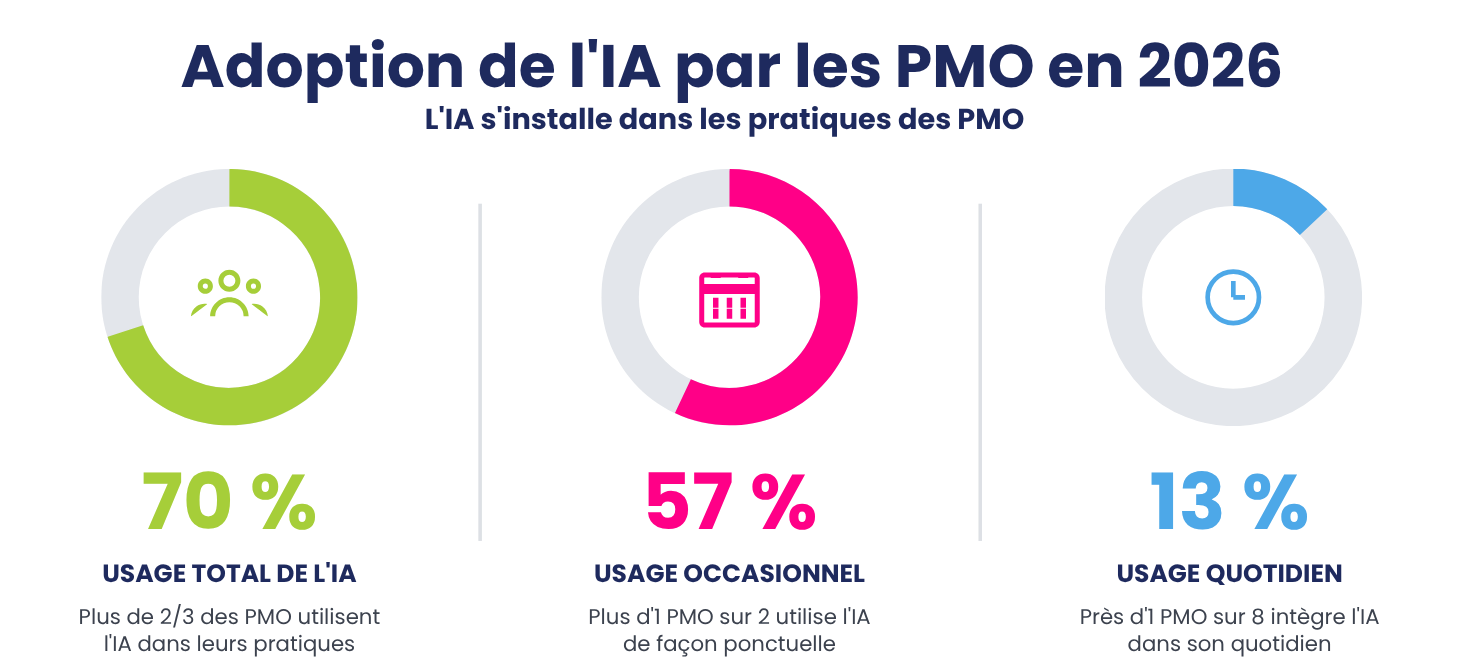
70% of PMOs already use artificial intelligence
Artificial intelligence is becoming an integral part of the modern PMO (Project Management Office).
This statistic confirms an important reality: AI is no longer a future trend, it is increasingly embedded in day-to-day PMO practices.
But beyond the excitement, one key question remains:
Is AI fundamentally transforming the role of the PMO, or simply accelerating existing processes?
PMOs and AI: what does it really mean?

AI in the context of a Project Management Officer refers to the use of artificial intelligence to automate, enhance, and improve project and portfolio management activities.
In practice, AI enables PMOs to:
- Automate repetitive tasks
- Analyze large volumes of project data
- Generate summaries and management reports
- Detect risks and potential project deviations early
The challenge is not purely technological.
It is organizational and strategic: using AI to improve the quality of decision-making, not simply to complete tasks faster.
Why AI Is becoming essential for PMOs
Most PMOs don’t suffer from a lack of methodologies or project management tools.
What they often lack is time.
Between:
- Consolidating project data
- Preparing portfolio review meetings
- Monitoring KPIs
- Supporting governance decisions
…a significant portion of a PMO’s workload is still dedicated to necessary, but low-value, administrative activities.
The objective is therefore not simply to speed up these tasks.
The real opportunity lies in freeing up time so PMOs can focus on their highest-value responsibility: supporting better business decisions.
PMOs & AI in 2026
According to our PMO industry survey, artificial intelligence has become firmly established in project and portfolio management practices.
Practical AI Use Cases for PMOs
The value of AI isn’t based on distant promises.
It’s already delivering measurable benefits through practical, everyday use cases.
Automating reporting
Preparing governance meetings and executive reviews remains one of the PMO’s most time-consuming responsibilities.
AI can automatically generate:
- Project summaries
- Status reports
- Presentation materials
The result is immediate time savings without requiring organizations to redesign their existing processes.
Anticipating issues instead of reacting to them
One of AI’s greatest strengths is its ability to detect weak signals before they become major problems.
Rather than identifying issues after they occur, AI helps PMOs:
- Detect potential project deviations
- Anticipate schedule delays
- Recommend possible adjustment scenarios
This shifts the PMO from a reactive role to a proactive one.
Improving data quality before decisions are made
One of AI’s most valuable operational use cases is improving data quality.
At Virage Group, we recently introduced a practical example: an automated project data consistency check capable of detecting discrepancies between project statuses, dates, and key fields before a portfolio review takes place.
In practice, this enables organizations to:
Concrètement, cela permet de :
- Identify inconsistencies that might otherwise go unnoticed
- Improve confidence in governance decisions
- Increase the overall quality of project data
This is a practical example of AI strengthening project governance by improving the reliability of decision-making.
Optimizing resource management
Resource management remains one of the biggest challenges for PMOs.
AI helps organizations:
- Analyze workload in real time
- Detect resource imbalances
- Simulate multiple allocation scenarios
The result is a more dynamic and reliable approach to capacity planning.
How AI Is transforming the role of the PMO
Historically, much of the PMO’s role has centered around producing information:
- Consolidating project data
- Preparing executive reports
- Monitoring KPIs
These activities remain essential.
However, they also limit the PMO’s ability to focus on strategic analysis.
AI’s greatest contribution is reducing this operational workload.
This fundamentally changes the PMO’s role:
- Less time producing information
- More time analyzing data
- Greater strategic contribution
As the profession continues to evolve, the PMO is becoming less of a reporting function and more of an orchestrator of data, insights, and strategic decision-making.
Not all AI applications deliver the same value
Not every type of AI provides the same level of business impact.
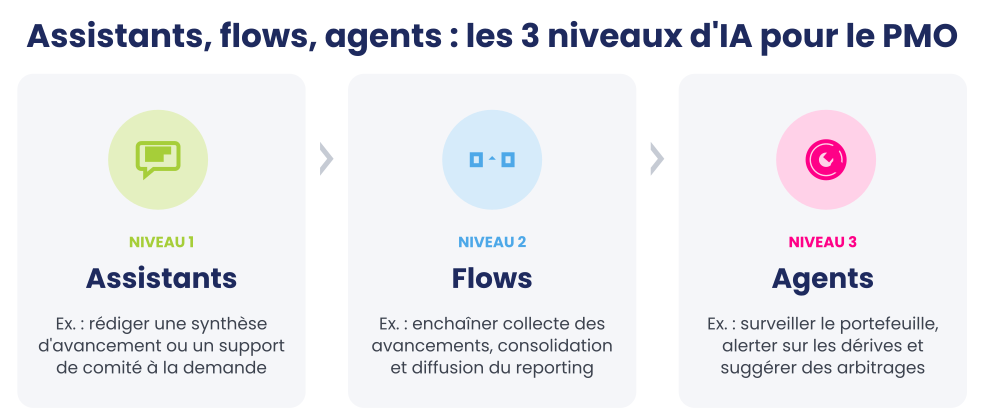
AI capabilities generally fall into three categories:
- AI Assistants : Respond to individual requests or prompts.
- AI Workflows : Automate sequences of repetitive tasks across multiple steps.
- AI Agents : Continuously monitor information, detect emerging issues, and proactively make recommendations.
Today, most PMOs are still operating at the assistant level.
The greatest opportunity lies in adopting more advanced AI capabilities that proactively support project governance and portfolio management.
The limitations of AI for PMOs
Despite its potential, AI can only deliver value when the right foundations are in place.
Data quality comes first
AI is only as reliable as the data it analyzes.
If project information is incomplete, inconsistent, or poorly structured, AI-generated outputs will also be unreliable. Instead of correcting poor data, AI often amplifies existing issues.
Ensuring high-quality project data is therefore a prerequisite for successful AI adoption.
Supporting teams through change
Introducing AI is not just about deploying new technology, it requires evolving the way teams work.
Successful adoption depends on an organization’s ability to:
- Train teams on new AI capabilities
- Develop new skills
- Integrate AI into everyday project management practices
Technology alone is never enough.
Keeping humans in control
Not every decision should be automated.
While AI can analyze information, detect patterns, and generate recommendations, PMOs remain responsible for:
- Interpreting results
- Providing business context
- Making informed decisions and trade-offs
AI supports decision-making, it does not replace it.
What to consider before deploying AI in your PMO
AI can generate significant business value, but successful deployment requires careful preparation.
Three factors are particularly important.
Data quality is non-negotiable
AI does not fix poor data, it magnifies it.
If your PPM solution contains incomplete records, inconsistent statuses, or outdated project information, AI outputs will reflect those weaknesses.
Before introducing AI, organizations should conduct a thorough review of their existing project data to identify issues such as:
- Missing information
- Outdated project statuses
- Inconsistent dates
- Poorly structured data
A clean and reliable data foundation is essential.
Protect sensitive project data
PMOs often work with highly sensitive information, including:
- Project budgets
- Resource allocations
- Financial forecasts
- Strategic initiatives
Before sharing this information with external AI assistants, organizations should verify:
- How providers process and store data
- Which information can safely be shared with third-party models
- Which data must remain within internal systems
- Compliance with GDPR and organizational security policies
These questions should be addressed before deployment, not afterward.
ROI is real, but it takes time
The benefits of AI are well documented:
- Faster reporting
- Better data quality
- More informed decisions
However, these gains are not immediate.
The first weeks are typically dedicated to:
- Learning new workflows
- Refining prompts
- Adjusting working habits
Organizations should therefore establish realistic expectations and measure value over time rather than expecting instant results.
A practical framework for introducing AI into your PMO
One of the most common mistakes organizations make is trying to transform everything at once.
The most successful PMOs introduce AI gradually by solving real operational challenges first.
A pragmatic approach typically follows three phases.
Phase 1: Identify a real pain point
Every successful AI initiative begins with a simple question:
Where is the PMO currently losing the most time?
Examples include:
- Preparing portfolio governance meetings
- Validating project data before executive reviews
- Writing project status summaries
The objective is not to automate everything.
It is to identify one specific, measurable problem where AI can deliver immediate value.
Phase 2: Standardize and measure
Once a use case has proven valuable, the next step is to make it repeatable.
This involves:
- Standardizing prompts to ensure consistent outputs
- Defining clear KPIs to measure success
- Tracking metrics such as time saved, errors detected, and deliverable quality
- Involving project teams early to adapt AI usage to real operational needs
Continuous improvement is more important than perfection.
Phase 3: Scale what works
Once measurable benefits have been demonstrated, successful use cases can be extended across:
- Additional business processes
- More project teams
- Different portfolios
- New organizational contexts
AI adoption should grow organically based on proven value.
From concept to daily practice: AI as the PMO’s copilot
To unlock its full potential, AI must be embedded into real PMO workflows, not used as an isolated tool.
With this objective in mind, Virage Group has developed a dedicated AI Prompt Library specifically for PMOs.
These prompts help users:
- Analyze project portfolios
- Generate executive summaries
- Prepare governance meetings
- Identify project risks
Developed by PPM experts, the prompts are compatible with leading AI models, including:
- ChatGPT
- Mistral
- Claude
- Gemini
The library continues to evolve through collaboration with the HUB PMO community, where Project monitor users from a wide range of industries share practical use cases, feedback, and best practices.
To access the prompt library dedicated to Project Monitor: AI Prompt Library
The new skills every AI-enabled PMO needs
Integrating AI into PMO practices requires more than learning a new tool.
It calls for a new set of professional capabilities.
Prompt engineering: designing effective prompts for better project management
Generative AI only produces valuable results when given clear, contextual instructions.
Prompt engineering, the ability to design effective prompts, has become an operational skill for modern PMOs.
Whether summarizing a project portfolio, identifying risks, or preparing governance meetings, the quality of the prompt directly impacts the quality of the output.
This philosophy underpins Project monitor’s AI Prompt Library: prompts created by PPM experts for real-world project management scenarios.
Data literacy: understanding data to drive better decisions
AI increases the value of data, but it also magnifies poor-quality information.
PMOs must understand:
- How project data is structured
- The limitations of available information
- Potential inconsistencies and biases
- How to collaborate effectively with IT and data teams
This skill becomes even more critical as AI helps ensure data reliability before governance committees, as demonstrated by the data consistency check available in Project Monitor, while the PMO remains responsible for validating findings and adding the necessary business context.
Technology orchestration: managing an ecosystem of tools, not just a single solution
Tomorrow’s PMO will no longer rely on a single project management tool.
Instead, it will operate within an integrated ecosystem that combines:
- A PPM platform such as Project monitor
- AI assistants such as ChatGPT, Mistral, Claude, and Gemini
- Reporting and visualization tools
- Automated workflows
Technology orchestration is the ability to coordinate these solutions effectively: knowing when to rely on AI, when human expertise is required, and how to connect technologies into a seamless decision-making workflow.
This is not purely a technical capability.
It is a strategic project management competency at the heart of the modern PMO role.
The rise of the augmented PMO
Artificial intelligence isn’t replacing the PMO.
It’s redefining its role.
Tomorrow, the value of a PMO will no longer be measured solely by its ability to monitor projects, but by its ability to analyze information, anticipate challenges, and support better business decisions.
The real transformation isn’t technological, it’s organizational and strategic.
This evolution reflects a broader trend across Project Portfolio Management: the PMO is increasingly becoming a strategic partner, focused on insight, foresight, and decision support rather than administrative reporting.
How AI Is changing the PMO profession
Artificial intelligence won’t transform the PMO overnight.
Instead, it is gradually reshaping the role.
By automating repetitive activities, AI frees up valuable time.
By analyzing project data, it provides clearer insights that support better decisions.
This is where the real transformation happens:
PMOs move from being primarily focused on project reporting to becoming true drivers of portfolio value.
Rather than spending most of their time producing information, they can dedicate more effort to strategic analysis, governance, and helping organizations make better investment decisions.
Sources :
Project Management Institute Nouvelle fenêtre
PMOGA – PMO Global Alliance Nouvelle fenêtre
Tyson Brown Nouvelle fenêtre
Frequently Asked Questions
What is the role of AI in a PMO?
AI helps PMOs automate repetitive tasks, analyze project data, and support decision-making.
Typical use cases include: generating project summaries, producing management reports, detecting project risks, improving data quality, supporting portfolio governance
Rather than replacing project management expertise, AI enables PMOs to focus on higher-value strategic activities.
Will AI replace the PMO?
No.
AI enhances the PMO’s capabilities, but it cannot replace professional judgment, business expertise, or governance responsibilities.
The PMO remains responsible for interpreting information, providing organizational context, prioritizing initiatives, and supporting executive decision-making
AI serves as an assistant, not a decision-maker.
What are the main benefits of AI for PMOs?
Organizations adopting AI within their PMOs typically experience benefits such as significant time savings, higher-quality project data, earlier identification of risks, faster reporting, better-informed decisions, and improved project governance
Ultimately, AI enables PMOs to spend less time collecting information and more time creating value.
Which AI tools can PMOs use?
PMOs can leverage a wide range of AI solutions depending on their needs, including: ChatGPT, Mistral, Claude, Gemini, AI copilots, and Project Portfolio Management (PPM) platforms with built-in AI capabilities, such as Project monitor.
The most effective approach is to combine specialized PPM software with AI assistants to automate routine work while maintaining full human oversight.

